All itineraries
— Mexico City · Mexico

Three Days in the Capital

Mexico City's monuments, museums, and grand public spaces, one extraordinary site at a time

3 days18 stopsSMOVECITY EditorsUpdated October 2026

cultureclassicoutdoorsweekend
Three Days in the Capital — Mexico City

This three-day route moves through Mexico City's greatest layers — the colonial core, the park-anchored Reforma corridor, and the quieter residential west — letting the city's architecture and history speak at their own pace. Each day follows a natural geographic arc so you walk more and commute less. No meals, no bars, no filler: just the places themselves.

Day 1

  1. 09:00

    Zócalo — The Heartbeat of the City

    ~45 min

    Begin where the city began. The Zócalo is one of the largest public squares in the world, and arriving early means you catch the Mexican flag ceremony with space to breathe. The sheer scale of the plaza — framed on every side by centuries of civic architecture — sets the tone for everything that follows.

    Zócalo — The Heartbeat of the City
  2. 09:50

    Mexico City Metropolitan Cathedral

    ~60 min

    Right on the Zócalo's north edge, the Cathedral took nearly 250 years to complete and shows it — Baroque, Neoclassical, and Churrigueresque styles collide across its façade and twin bell towers. Step inside to find side chapels dense with gilded altarpieces and the quietly unsettling Altar of Forgiveness.

    Mexico City Metropolitan Cathedral
  3. 11:00

    Templo Mayor

    ~90 min

    Immediately northeast of the Cathedral lies the excavated heart of the Aztec capital Tenochtitlán. The ruins themselves are striking — successive temple platforms exposed layer by layer — and the on-site museum holds the enormous Coyolxauhqui stone and thousands of ritual offerings unearthed since 1978.

    Templo Mayor
  4. 13:00

    National Palace

    ~75 min

    Closing the east side of the Zócalo, the National Palace is where Diego Rivera painted his sweeping mural panorama of Mexican history across the grand staircase and upper arcade. The murals reward slow looking — find the market of Tlatelolco, the Spanish conquest, and the dream of a socialist future all within a single wall.

    National Palace
  5. 15:00

    Museo Nacional de Arte

    ~90 min

    A short walk west toward Tacuba Street brings you to the MUNAL, housed in an Italian Renaissance-style palace built in the early 20th century. Its collection spans five centuries of Mexican art, from colonial-era religious painting to the great muralists, and the building's ornate staircase — guarded by a bronze equestrian El Caballito sculpture — is an attraction in itself.

    Museo Nacional de Arte
  6. 16:45

    Palace of Fine Arts

    ~60 min

    End the day at the Palacio de Bellas Artes, whose white Carrara marble exterior glows amber in the late afternoon light. The Art Nouveau exterior gives way to an Art Deco interior of stained glass, onyx, and murals by Rivera, Orozco, Siqueiros, and Tamayo. Even if you only walk the public galleries, it is unlike any other building in the hemisphere.

    Palace of Fine Arts

Day 2

  1. 09:00

    Alameda Central Park

    ~45 min

    Start the second day on the benches of the Alameda, Mexico City's oldest public park. Laid out in the late 16th century, it is a grid of fountains, bronze statuary, and tall ash trees that filters the morning light into something almost theatrical. The Hemiciclo a Juárez monument anchors the south side.

    Alameda Central Park
  2. 10:00

    Paseo de la Reforma

    ~60 min

    Walk west along the Reforma, the grand diagonal boulevard commissioned by Emperor Maximilian in the 1860s to connect the castle to the city center. The avenue is lined with traffic roundabouts that double as open-air sculpture galleries — pause at each glorieta to read the monument before pressing on toward Chapultepec.

    Paseo de la Reforma
  3. 11:00

    Angel of Independence

    ~30 min

    The winged golden figure atop her 36-metre column has been Mexico City's most recognizable landmark since 1910, when it was unveiled to mark the centenary of independence. The column base holds the remains of independence heroes and the surrounding glorieta is a traditional gathering point whenever the national football team wins.

    Angel of Independence
  4. 12:00

    Chapultepec Castle

    ~90 min

    Climb Chapultepec Hill to the only royal castle in mainland North America, used by Aztec rulers, Spanish viceroys, Emperor Maximilian, and Mexican presidents in succession. Today it houses the Museo Nacional de Historia; its terrace offers one of the best elevated views of the Reforma corridor stretching back toward downtown.

    Chapultepec Castle
  5. 14:00

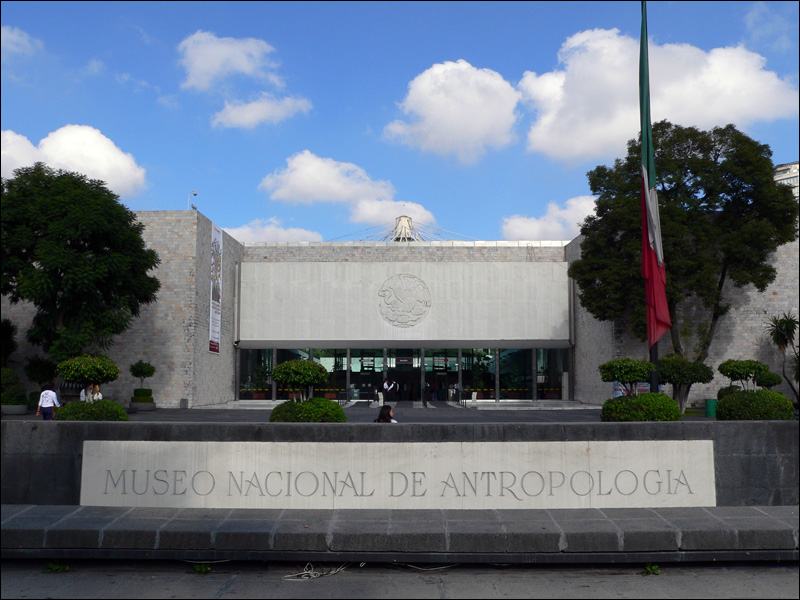
    National Museum of Anthropology

    ~120 min

    At the base of the hill, the Museo Nacional de Antropología is arguably the finest anthropology museum in the world. Pedro Ramírez Vázquez's 1964 building organizes 23 rooms around a rain-catching umbrella canopy in a central courtyard. The Aztec Sun Stone and the reconstructed tomb of Pakal the Great are among the objects that genuinely stop visitors in their tracks.

    National Museum of Anthropology
  6. 16:30

    Torre Mayor

    ~45 min

    Finish the afternoon at the 55-storey Torre Mayor, the tallest building in Mexico when it opened in 2003. Its observation areas frame the Reforma below and the forested mass of Chapultepec behind it — a useful final vantage point to mentally map the two days you have spent on the ground.

    Torre Mayor

Day 3

  1. 09:30

    Luis Barragán House and Studio

    ~75 min

    The third day turns west to Tacubaya, where the UNESCO-listed home and studio of architect Luis Barragán has been preserved exactly as he left it. Visits are by guided tour only, so arriving promptly matters. The interior — volcanic stone walls, timber beams, pools of colored light from yellow, pink, and blue glass panels — is both deeply personal and profoundly architectural.

    Luis Barragán House and Studio
  2. 11:30

    Frida Kahlo Museum

    ~90 min

    Head south to Coyoacán and the cobalt-blue Casa Azul where Frida Kahlo was born, lived most of her life, and died. The house holds her collection of pre-Columbian objects, her corsets and medicines, her studio with the mirror above the bed, and a revolving selection of her paintings. Book timed entry in advance — demand is year-round.

    Frida Kahlo Museum
  3. 14:00

    Plaza de las Tres Culturas

    ~60 min

    North to Tlatelolco for a single plaza that holds three eras of Mexican history in physical adjacency: Aztec market ruins at the base, a 16th-century Spanish colonial church rising from their stones, and a 1960s modernist government tower behind. A plaque marks the site of the 1968 student massacre — the weight of the place is impossible to ignore.

    Plaza de las Tres Culturas
  4. 15:15

    Senate of the Republic

    ~45 min

    A short ride back toward the Reforma brings you to the Senate building, whose public areas feature striking murals and a modernist interior that rarely appears on tourist maps. It is a working legislature, so exterior appreciation and any publicly accessible foyer areas give you a quieter, less-photographed slice of Mexico City's civic architecture.

    Senate of the Republic
  5. 16:15

    Torre Ejecutiva Pemex

    ~45 min

    Close to the Reforma, the cylindrical Pemex tower is a bold piece of 1980s corporate modernism — a concrete and glass drum that cuts a very different silhouette from the city's colonial spires and glass-curtain skyscrapers. Worth a circumnavigation for its sheer structural confidence as the light softens into early evening.

    Torre Ejecutiva Pemex
  6. 17:30

    Palacio de los Deportes

    ~45 min

    End the trip at the copper-domed Palacio de los Deportes in Iztacalco, designed by Félix Candela and Enrique Castañeda Tamborell for the 1968 Olympics. The geodesic copper shell — one of the great feats of structural engineering in Latin America — is best appreciated from the surrounding esplanade as the evening sky shifts behind it.

    Palacio de los Deportes

Good to know

How many days do I need for Mexico City?

Three Days in the Capital covers Mexico City in 3 days, with 18 planned stops. You can follow it exactly as published, or shorten and extend days after opening it in the SMOVECITY app.

Can I customize this itinerary?

Yes. Opening it in the SMOVECITY app turns it into your own editable trip — reorder days, add or remove stops, and invite friends to plan together with live co-editing.

How do I get around in Mexico City?

The SMOVECITY app shows public transport, shared bikes, e-scooters and other mobility options in Mexico City on one live map, so you can compare routes between the stops on this itinerary as you go.

Planning the practical side? How to get around Mexico City

Make this itinerary yours

Open it in the SMOVECITY app to turn it into your own trip — edit the days, invite friends, and get around Mexico City with live transit and shared mobility.